Slide Film Scanning Service
Slide Film Digitised At The Highest Possible Quality.
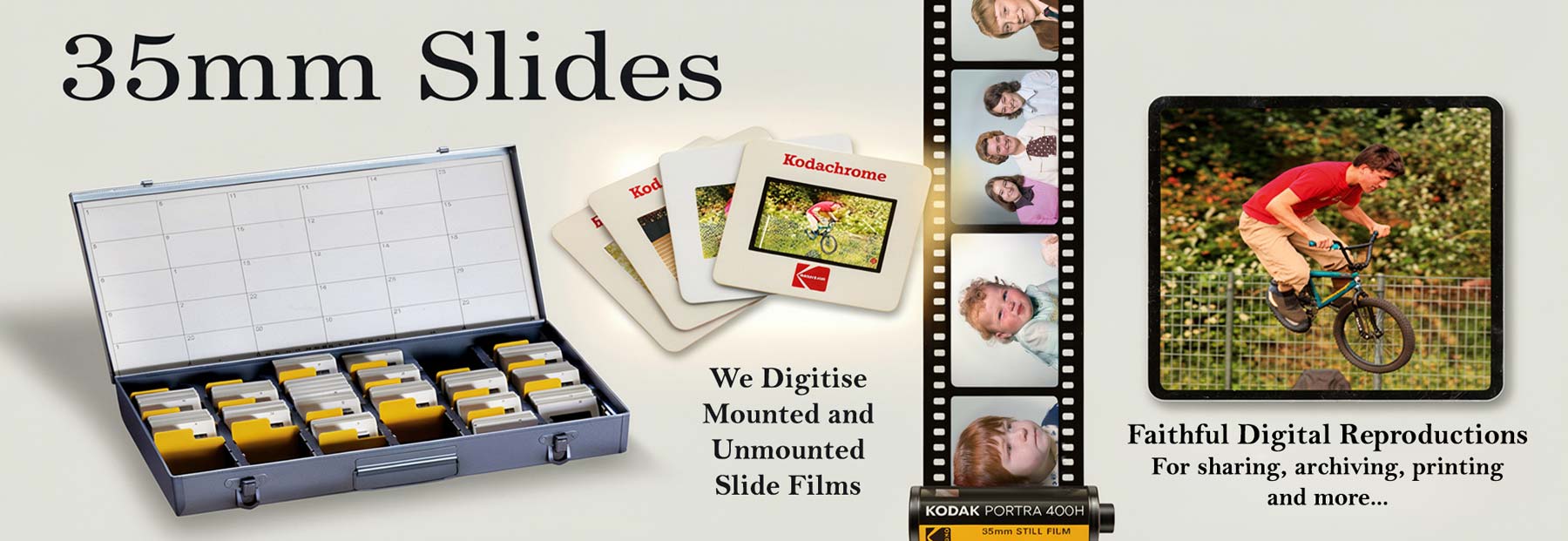
Prices for 35mm slides
1 – 9 slides
60p each
10 – 49
40p each
50 – 99
35p each
100 or more
30p each
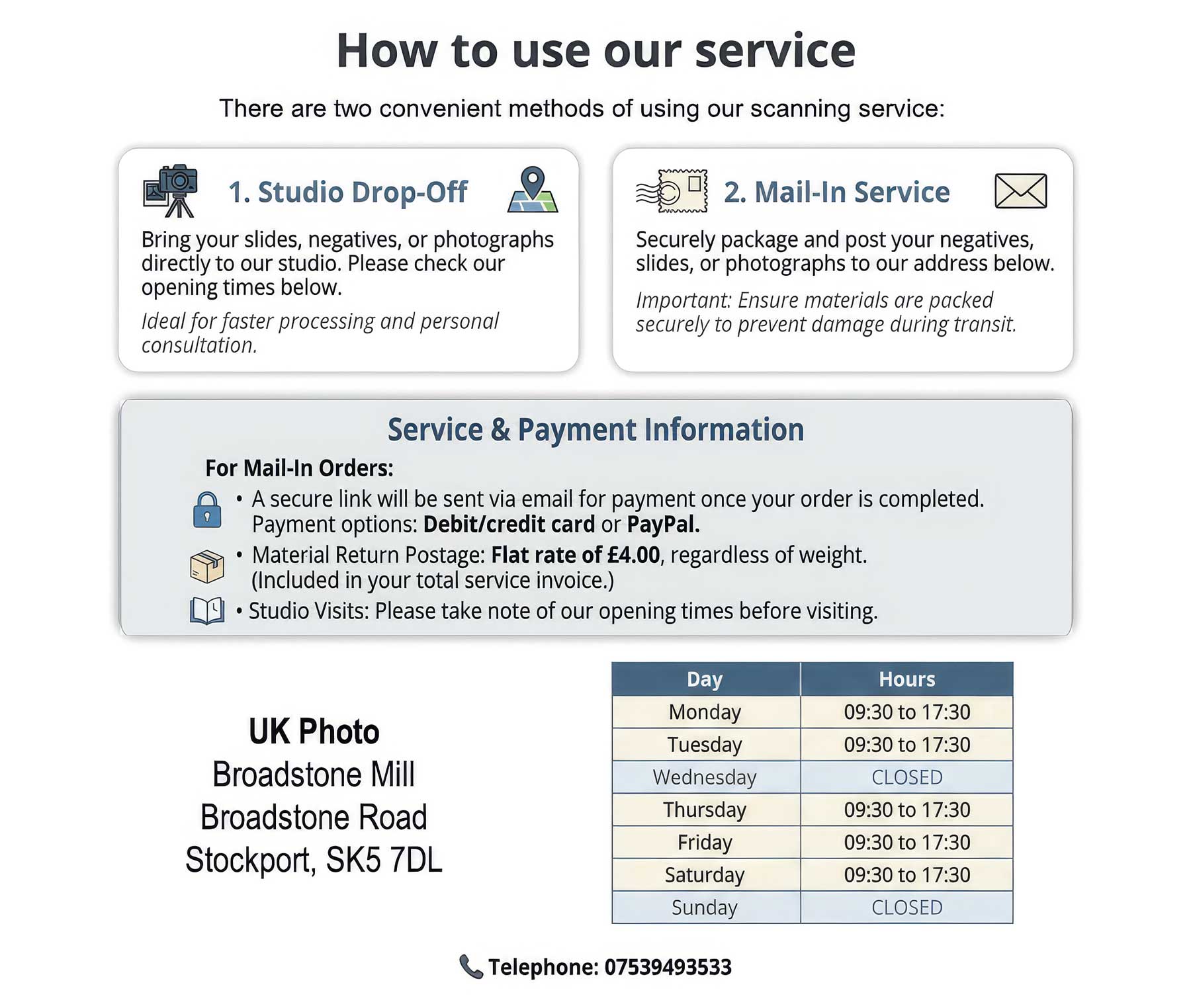

Slide Film Scanning Inquiries
If you have any questions regarding our scanning service, please enter them in the box above.
Enter either your email address or telephone number depending upon how you would like us to contact you.
The condition of your slides
Over years of handling and storage, slide film inevitably accumulates grime. Viewed under a microscope, this contamination is revealed as a motley collection of insects and fragmented insect matter. Such debris bonds stubbornly to the emulsion and resists the usual pre‑scan treatments with blowers or brushes.Modern scanning technology can mitigate the problem to a degree: many contemporary scanners employ infrared channels capable of detecting foreign material on the film surface and removing it digitally.
Slide film, however, presents a particular complication. Its emulsion retains a significant amount of silver, and this silver is mistakenly interpreted by the hardware and software as unwanted artefacts. The consequence is that infrared based cleaning systems, such as ICE or iSRD, are largely ineffective for slide film and, in most cases, cannot be used at all.
Below is a summery of slide film variations as they pertain to scanning:
E‑6 Colour Transparencies (Velvia, Provia, Ektachrome)
- Pros — Fine grain, sharp detail, stable colour; generally excellent for modern scanners.
- Cons — Narrow latitude; Velvia’s contrast can block shadows.
- Silver‑Retention Impact — Most E‑6 films have minimal residual silver, so infra‑red dust and scratch removal (ICE) works reliably.
Kodachrome
- Pros — Exceptional archival stability, ultra‑fine grain, rich tonal depth.
- Cons — Higher contrast; all stock is ageing.
- Silver‑Retention Impact — Kodachrome retains significant silver in all layers, which blocks IR light. As a result, ICE is ineffective, and dust must be removed manually.
Agfa, Ferrania & Other Legacy Stocks
- Pros — Distinctive colour palettes; moderate grain; attractive scans with correction.
- Cons — Age‑related fading and colour casts; limited dynamic range.
- Silver‑Retention Impact — Many older emulsions retain more silver than modern E‑6, leading to partial or unreliable IR cleaning.
Black‑and‑White Slide Films (e.g., Scala)
- Pros — Very sharp, low grain, excellent for large digital output.
- Cons — High contrast can crush detail.
- Silver‑Retention Impact — B&W slides contain pure silver images, so ICE cannot function; every speck of dust must be physically cleaned or digitally retouched.
Potted History of Slide Film (35mm)
From cinema stock to still photography (1910s–1930s)
35mm began as motion‑picture film, standardised at 24×36 mm. Oskar Barnack’s Leica prototypes proved the format’s potential for still photography, but early use was limited to black‑and‑white negative stock. Colour slides had yet to appear.The birth of colour reversal (1930s–1950s)
Kodachrome (1935) introduced colour reversal film, producing a positive image directly on the strip. Its complex K‑14 process delivered exceptional sharpness and longevity. Agfacolor Neu (1936) simplified processing with integral colour couplers, laying the groundwork for later slide emulsions. By mid‑century, 35mm transparencies were the standard for projection and editorial work.Standardisation and widespread adoption (1950s–1970s)
The 2×2‑inch slide mount became universal, enabling easy projection and archiving. Ektachrome, refined through the 1950s, offered a more accessible alternative to Kodachrome via the E‑3 and later E‑6 processes. With the rise of SLR systems such as the Nikon F, slide film became the professional choice for commercial, scientific, and magazine photography.Peak era: saturation and precision (1970s–1990s)
Slide film reached its creative peak with emulsions like Fujichrome Velvia and Provia, prized for fine grain and vivid colour. Kodachrome 25 and 64 remained benchmarks for natural colour and archival stability. Tight exposure latitude shaped a disciplined photographic culture, and transparencies dominated stock libraries, editorial workflows, and projection‑based presentations.Decline in the digital age (2000s–2010s)
Digital capture rapidly displaced slide film. Kodachrome processing ended in 2010, marking the end of an era. Many E‑6 films were discontinued, and specialist labs became scarce, reducing accessibility for everyday photographers.Niche survival and analogue revival (2010s–present)
Despite contraction, 35mm slide film persists. Fujifilm Provia 100F and Velvia 50 remain available, supported by dedicated labs running E‑6. Slide projection has become a cult analogue experience, valued for its colour fidelity, luminous presentation, and archival stability.UK-Photo, Broadstone Mill, Broadstone Rd, Reddish, Stockport, SK5 7DL • TEL:
07539493533
• eMail: info@uk-photo.com
Our studio/shop is located between Manchester and Stockport. Our studio customers come from across the Northwest of England.
©2026 - Copyright uk-photo.com